
Webnovel Series by A Amankwaa
©2025 A Amankwaa. All rights reserved.
The salt-heavy air of Cape Coast stung Ato’s eyes, but he barely noticed. He sat in a dimly lit corner of a roadside waakye joint, his eyes glued to the flickering television mounted on the wall. The news was still looping images of the galamsey raid, the yellow clay, the handcuffs, and Abudu’s face, frozen in a mask of defeat. Ato’s hands shook as he reached for his pure water. He wasn’t just hiding from the police; he was hiding from the ghost of what they had done at the mining site.
“You look like a man who has seen a fetish priest’s curse,” Nkansah said, sliding into the plastic chair opposite him. Nkansah was a ‘connection man’, a merchant of hope and dangerous borders. He leaned forward, the smell of cheap cigarettes and old secrets clinging to his shirt. “I need to leave, Nkansah. Now,” Ato whispered, his voice jagged. Nkansah let out a slow, whistling breath. “The Sahara route? Through the desert and Lybia? That road is paved with the bones of boys who thought they were brave. It is not for the weak.” He looked Ato up and down, his eyes like a merchant weighing a heavy sack of grain. “I can get you across the borders, but once we hit the sand, your life is in your own hands. You sure say you get the odeshi for this?”
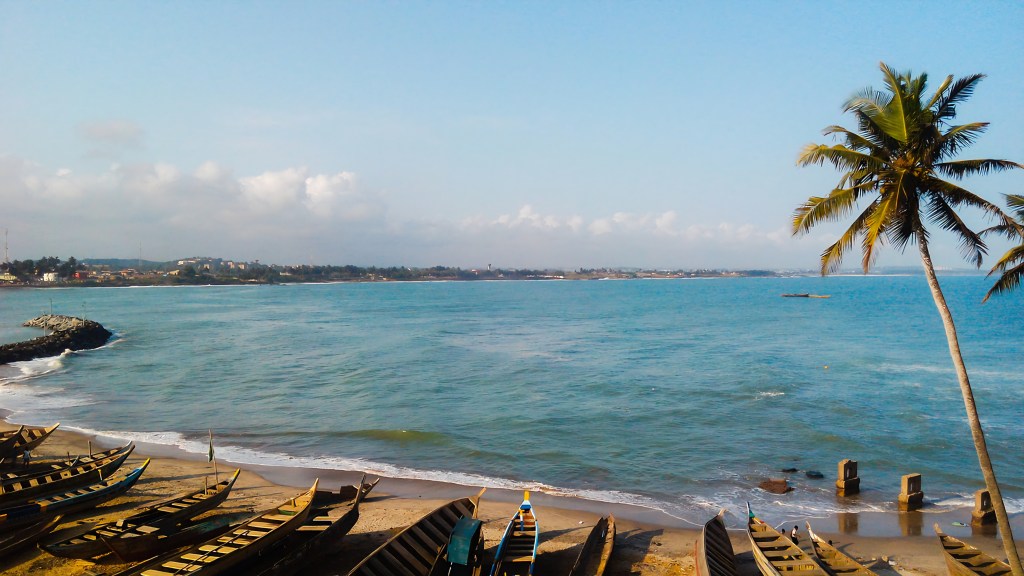
Ato looked away, watching the slow, steady swell of the Atlantic Ocean in the distance. He thought of the bloodstained clothes he had buried, or thought he had buried. He thought of Abudu sitting in a cell in Oda. “Charley, life hard for here,” Ato lied, though the truth was clawing at his throat. “I for make am. I have to take care of my family. Nothing dey work for here.” Nkansah nodded slowly, reaching for a piece of paper to write down a price. But as Ato reached for his wallet, his mind wasn’t on Europe. He was calculating the distance between the Cape Coast waves and the dark, silent roots of the Big Tree. He needed to be gone before the ‘Forensic Window’ Dr. Nhyira spoke of finally opened wide enough to reveal his face.
The pungent, silver scent of fresh fish from the morning’s catch hung heavy over the seaside, but it was the weight of the “connection” meeting that truly blinded Ato. As he walked away from the chop bar, the scrap of paper with Nkansah’s price felt like a lead weight in his pocket. He was a man planning a flight across the Sahara, yet his legs felt too heavy to carry him across the street.
The “gig” with Abudu, the things they had done near the Big Tree, tugged at his soul like a hook. Before he could talk himself out of it, he found his feet leading him toward the stone arches of the cathedral. He didn’t want a blessing; he wanted an exorcism. Inside the wooden confessional, the air was hot and stagnant, smelling of old incense and polished cedar.
Ato leaned his forehead against the screen, the mesh biting into his skin. His head throbbed with a migraine so fierce it felt like a rhythm of hammer blows behind his eyes, each one synced to the frantic, irregular gallop of his heart. He couldn’t see Father Frank through the dark veil, but he could hear the priest’s steady, patient breathing. It made Ato feel even more like a hunted animal.
“Will God forgive a man… who kills another person?” Ato’s voice was a jagged whisper, barely audible over the blood rushing in his ears. There was a long, heavy silence from the other side of the screen. When Father Frank finally spoke, his voice was calm, but it carried the weight of a mountain.
“God’s mercy is a vast ocean, my son. He forgives even the darkest stain if the heart is truly broken.” The priest paused, and Ato felt the shift of weight on the wooden bench. “But forgiveness is not an escape. God calls us to be accountable for our hands. To submit to the laws of the land and make right what we have made wrong. Mercy requires truth.”
Ato squeezed his eyes shut, a single bead of sweat rolling down his temple. He had come looking for a hall pass to Europe, a way to quiet the ghosts so he could cross the desert with a light soul. But the priest’s words felt like another set of handcuffs.
He didn’t say another word. He stood up, the wooden door creaking as he pushed his way back into the empty, echoing nave of the church. He had his answer, but it wasn’t the one that would help him sleep.
Back in Oda, the hallway outside the interrogation room felt smaller than usual, the air thick with the smell of floor wax and the savory, lingering aroma of tuo zaafi from the afternoon canteen break. Dr. Nhyira didn’t wait for Ansah to catch his breath. She stepped into his path, composed and unmistakably professional, standing out against the dingy, yellowed walls of the precinct.
“You’re playing a dangerous game, Inspector,” she said, her voice low but vibrating with a controlled edge. Ansah wiped a bead of sweat from his forehead, his folder tucked tightly under his arm. “He was cracking, Doctor. You saw his feet. He’s hiding something.”
“He’s hiding fear, which is not the same as guilt,” Nhyira countered. She stepped closer, forcing him to meet her gaze. “DNA is not a confession. It is a biological trace. There are a dozen ways his DNA could have ended up on that hat, direct contact, secondary transfer, even shared laundry. By telling him it ‘tells a story,’ you’ve invited him to write a fiction that fits your narrative.”
She paced a short line in the corridor, her heels clicking a sharp, impatient rhythm. “We must be impartial. If we lose our objectivity, we lose the case. Right now, we have a shovel that potentially carries the DNA of the victims and the DNA of Abudu. It is a link, not a knot.”
She stopped and turned back to him, her expression softening into a look of professional urgency. “Forget the confession for a moment. We need to look at the fibers, the weave of that hat against the fragments we pulled from the graves. That is the physical bridge we need.” Ansah sighed, the adrenaline of the interview finally fading. “So what do you suggest?”
“A warrant,” Nhyira said firmly. “Search Abudu’s home. Search the groundsman’s quarters. We need to find the source of those fibers before they are burned or buried. If Abudu won’t give us the truth, we’ll have to find it in the walls of the place he sleeps.”
The telephone on the duty desk at the Oda police station rang with a shrill, persistent bite, cutting through the low hum of the station. Inspector Ansah, still wearing the weariness of the failed interrogation, snatched the receiver.
On the other end, the voice was thin and brittle, like dry grass. It belonged to Nana Ako. At eighty-seven, her words moved slowly, but they carried the clarity of someone who had spent four months counting the days of a growing silence.
“I heard the man on the radio,” she began, her voice trembling, not with age, but with a dawning, horrific suspicion. “The family… the skeletons you found under the tree. I am not sure… I pray it is not them, but my heart is heavy.” Ansah signaled for the sergeant to start the recording. The air in the room seemed to chill. “Go on, Nana. Tell us what you know.”
“My son, Kwabena, lives in Bodi with his wife and children,” she whispered. “I live here in Akim Nkunim, fifty kilometers away. We do not speak every day, but three months is too long even for a busy man. I have called and called, but the phone is just a dead thing. When the radio said you found a family, a father, a mother, and children, my blood went cold.”
She told him of their last conversation which was a frantic, whispered call, where Kwabena seemed terrified. He told her the children hadn’t returned from an “operation” at the mines at their usual time. He said he was going to meet the “Overseer” to demand answers, to bring the children back home. “He sounded… really worried,” Nana Ako said, a sob finally breaking through the thinness of her voice. “I was not worried at first. He is a grown man. But the radio says these people have been buried for months. That is the same time my Kwabena stopped calling.”
Ansah scribbled the address of the family in Bodi with a force that nearly tore the paper. “An Overseer,” he muttered as he hung up. “I will try and come tomorrow,” Nana Ako added, her resolve hardening. “I will take the first bus to Oda. I have to see. I have to know if it is my Kwabena.” Ansah stared at the recorded notes on his desk. The puzzle had just shifted. It wasn’t just a local village matter anymore. There was a hierarchy involved, a boss, an Overseer, and a family from Bodi who had vanished into the shadows of the mines. He thought of how this information fits the existing narrative and the scientific evidence.
The interrogation room felt even colder when Ntow sat in the chair. Unlike Abudu’s defiance, Ntow looked like a man who had already been hollowed out by life. He didn’t wait for a “No comment.” “Seven hundred cedis,” Ntow whispered, staring at his own calloused hands. “That is what they pay a groundsman at the Big Tree. Seven hundred for thirty days of work. And I have nine mouths to feed at home, Inspector. Nine.”
Ansah leaned back, his pen hovering over the log. “So you turned to the pits. You knew the laws on illegal mining. Those children should have been in school, Ntow, not digging in the earth.” “Hardship dey push we all, the children come on their own… with their parents support” Ntow replied, a single tear tracing a path through the dust on his cheek. “When the belly is empty, the law feels like a distant thing. I was a lookout. I took the extra money so my children could eat.”
Ansah leaned forward, his voice dropping to a sharp, focused edge. “Let’s talk about the ‘extra’ work, Ntow. Tell me about the accidents. Tell me about the lives lost in those pits. We heard news people died there but no official reports”. Ntow’s eyes darted to the door, fear momentarily eclipsing his exhaustion. “Everything… it is managed by the Boss. We don’t see him. We only hear the instructions through the Overseer.”
“Did a pit collapse four months ago?”
Ntow swallowed hard, his voice trembling. “I was not there that night. I was at the far end of the village. But when I returned the next morning, the air was different. People were whispering. They said a wall had given way and the mine had taken some workers… people drowned. I don’t know who they were or where they came from… people come from so many different places you see…”
He looked up at Ansah, his eyes pleading. “The Overseer told us to keep digging. He said things will be taken care of and the families informed. I don’t know where the bodies went. I didn’t ask. In the pits, if you ask too many questions, you become the next person they dig for. Talk to Abudu. He was there. He has the stomach for those details. I only have the stomach for the hunger.” Ansah stood up, the chair’s legs scraping the floor. The investigation had finally moved from a “maybe” to a “how.” The pit hadn’t just collapsed; it had been a grave from the start.

Something went wrong. Please refresh the page and/or try again.



 Scientect
Leave a reply to The Big Tree Murders – Scientect Cancel reply