
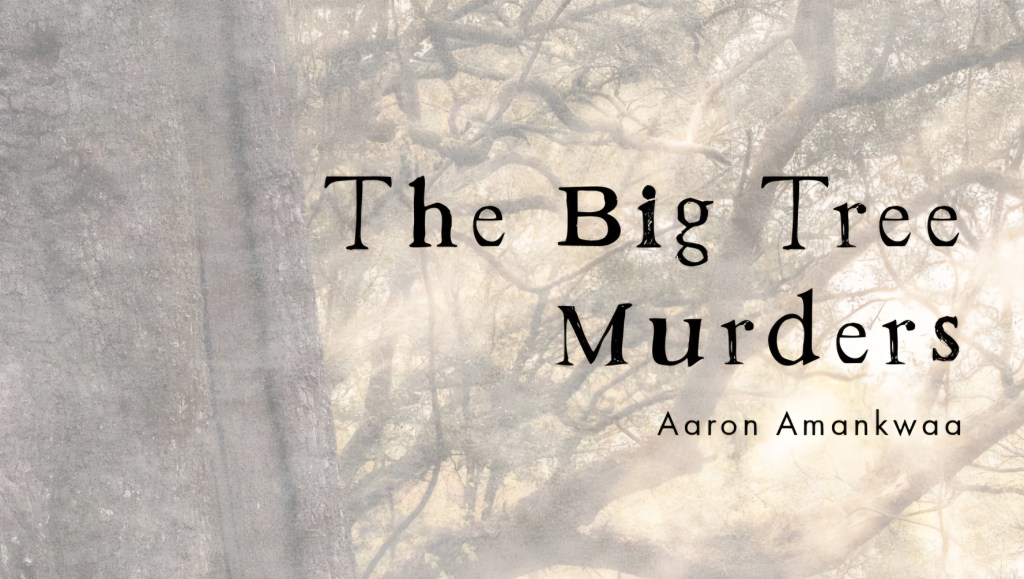
Webnovel Series by A Amankwaa
©2025 A Amankwaa. All rights reserved.
A week had passed since the Big Tree gave up its grim secret, and the residents of Akim Ntɛm, the village closest to the site, remained paralysed by shock. Ama Boye sat huddled near her radio, her children gathered close as the latest news bulletin played on Gyata Radio. Every few moments, she paused to shake her head, her voice a heavy whisper of disbelief. “Hmmm… eii… hmmm,” she murmured, “people are truly wicked!” Between the reports, she issued stern warnings to her children, forbidding them from wandering alone and echoing her usual, fearful mantra: “trust no one”.
While the police worked on the case, the village turned to legend. Rumours swirled through homes and the market stalls that a rogue fetish priest had claimed the lives for a dark ritual. Seeking to soothe both the living and the dead, the Chief of Ntɛm performed a solemn libation, pouring schnapps onto the parched earth as he called upon the ancestors for guidance and protections. He prayed for the gods to sharpen the eyes of the police and end this desecration of their land. To protect his people, acting on police counsel, the Chief enacted a strict curfew beginning at 4:00 p.m.
Now, as the sun dipped below the canopy, the village fell into an eerie, unnatural stillness, a silence so profound it felt like the dead of midnight.
The courtyard of the village palace was saturated with the scent of sacred herbs and the tension of a community under siege. The Chief, dressed in kobene, sat in sombre council with the elders and the traditional priest, debating how to cleanse the spiritual defilement of the sacred Big Tree.
Nana Konti, moving with a vigorous intensity, chanted words in a dialect so ancient it seemed to vibrate the very floorboards. After a long, trancelike dance, he finally spoke, advising the council to hold their hand. For now, the ancestors demanded they allow the law to run its course.
Despite the national outcry and the appeals echoing across every radio and TV station in the country, the silence remained unbroken. No families in Akim Ntɛm had been reported missing, and no relatives had yet stepped forward from the surrounding regions. The five victims remained ghosts, linked by blood, but forgotten by the living.
In the nearby town of Oda, the heavy click of a key in the front door signalled a homecoming. The familiar cadence of Inspector Ansah’s boots usually brought a sense of security to his household, but tonight, the sound felt leaden. Even Shaka, the family dog, sensed the shift. He approached with his tail wagging, expecting the usual greeting, but Ansah walked past him, his eyes distant and clouded by the images of the shallow graves. It was after he placed his wallet in the tray he realised he had forgotten the car keys in the van.
His wife, Serwaa, met him in the hallway. Seeing the slump in his shoulders, she didn’t ask for details; she simply stepped into his space and wrapped her arms around him in a long, silent embrace. “Honey,” she whispered into his chest, “let me know if you want to check in with Pastor Dan. I’ll take care of the kids tonight. Just eat your dinner and try to find some rest.”
On the other side of town, DCS Brako took his usual evening stroll along Liberty Street. It was a ritual he had adopted since moving to Oda, a way to decompress after the heavy atmosphere of the station. He stopped at a familiar stall, greeting the roasted corn seller with a weary nod. “The usual, Aunty Naa. With diced kube,” he said, requesting the refreshing coconut accompaniment enjoyed by so many locals. Aunty Naa handed him the warm, charred cob, her eyes searching his face. “You don’t seem yourself today, Kofi. Why? Have you missed your wife that much?” Brako offered a forced, tight-lipped smile as he reached for his wallet. “Oh, just a lot on my mind from the office, Aunty. A lot on my mind.”
As he walked away, his phone vibrated in his pocket. It was Akosua. “Kofi, are we still meeting?” her voice was light, but carried a hint of longing. “I’m already at the table waiting. Haven’t you missed me?” Brako paused, rubbing the back of his head. “Akosua… I’m on my way. Please, just be patient.”
At the restaurant, Akosua sat by the window, watching the slow, steady flow of traffic as workers returned home. She ordered a bottle of water and watched the streetlights flicker on, reflecting on their future. Occasionally, a cold shiver of fear touched her, the reality of dating a high-profile police officer, and a married man at that, was daunting. She held onto the fact that Brako and his wife were separated and navigating a divorce, but the complexity of it often kept her awake. “He must be under immense pressure”, she whispered to herself. “Well, no pain, no gain la”.
When Brako finally arrived, he greeted her with a gentle kiss on the cheek and slid a bar of chocolate across the table. “For you, my darling. I’m sorry I kept you waiting.” “It’s okay, Kofi,” Akosua said, reaching for his hand. “I know this case is draining you. You can talk to me, you know.”
Brako sighed, leaning back as the shadows deepened outside. “I can’t disclose details, of course, but it feels like we’re hitting a dead end at every turn. It’s the most challenging investigation I’ve ever managed.” He looked at her, his voice dropping an octave. “I keep seeing those children, Akosua. I can’t imagine this happening to my own family.” Akosua squeezed his hand firmly. “I believe in you, Kofi. I know you and the team will bring these people justice. You have to.”
Deep in the shadows of the village outskirts, far from the prying eyes of the police, Ntow, the groundsman of the Big Tree, met Abudu under the cover of a moonless night. Ntow was shaking, his eyes darting toward every rustle in the undergrowth. “Calm down,” Abudu hissed, his voice low and dangerous. “Why you dey shake like that?” “I heard them, Abudu. I heard the police talk,” Ntow whispered, his breath coming in short, ragged gasps. “They found a shovel. And tools. Right by the stream where we…” He trailed off, unable to finish the thought. “Did you burn the tools from the mining? I don’t want trouble, Abudu. I have seven children to feed.”
Abudu let out a cold, mocking laugh. “Aha, you dey fear? Now you are worried about your children?” Ntow grabbed his arm. “When you were ki…” “My friend, shut up! Keep quiet!” Abudu snapped, shoving him back. “It was a fight. A struggle. You know that.”
“So what did you do with the tools?” Ntow pleaded. “I handed them to Ato. I told him to dispose of them along with the bloodstained clothing,” Abudu said, though his own bravado seemed to falter for a second. “But Ato has travelled to his hometown. He hasn’t picked up his phone.”
Abudu stepped closer, his shadow looming over the smaller man. “Why you dey fear? This has nothing to do with those skeletons the police found. Those bones are old. Our… problem… is fresh. Calm down.” Ntow pulled his cloth tighter around his shoulders. “I have to leave before someone sees us. Follow up with Ato tomorrow. If the police find those clothes, we are finished.”
Inside the sterile, fluorescent-lit environment of the forensic laboratory, the atmosphere was a sharp contrast to the humid tension of Akim Ntɛm. The team, in consultation with Dr. Nhyira, worked with surgical precision to mount and examine the microscopic fibres recovered from the skeletal remains and the graves.
Nearby, in a separate laboratory, the items found by the stream, the shovel, the work gloves, and the knit hat, were being subjected to the same rigorous protocol by different scientists. The scientists moved carefully, using specialised lighting and fine tweezers to harvest any material that might link the tools to the graves or, perhaps, to any suspects hiding in the shadows.
Following strict protocol, all the exhibits had also been moved to the DNA unit. There, technicians worked to swab strategic areas and “contact points”, such as the handles, the inner linings, and the sweatbands, hoping to capture enough skin cells for a trace DNA profile.
Adusei, the lead scientist, stood in his office overlooking the lab, staring at a whiteboard covered in flowcharts. He was drafting the comprehensive forensic strategy, but a frown creased his forehead. He was deeply concerned about the “Forensic Window.” With at least three months having passed since the burials, and the items by the stream exposed to the harsh elements, the window was closing fast. He knew that environmental degradation could destroy DNA and bleach the colour from fibres, rendering even the most advanced tests useless.
He scratched the notepad so hard that the impression could be seen on the tenth page. There was another major problem, a break in the chain of custody of one exhibit, the shovel. Exhibits at the stream had also been collected by the same examiner. Every hour they spent in the lab was a gamble against the clock. The relevance of any future match depended entirely on what the elements had left behind. Yet all their hard work might be useless with poor scene work.



 Scientect
Leave a comment