
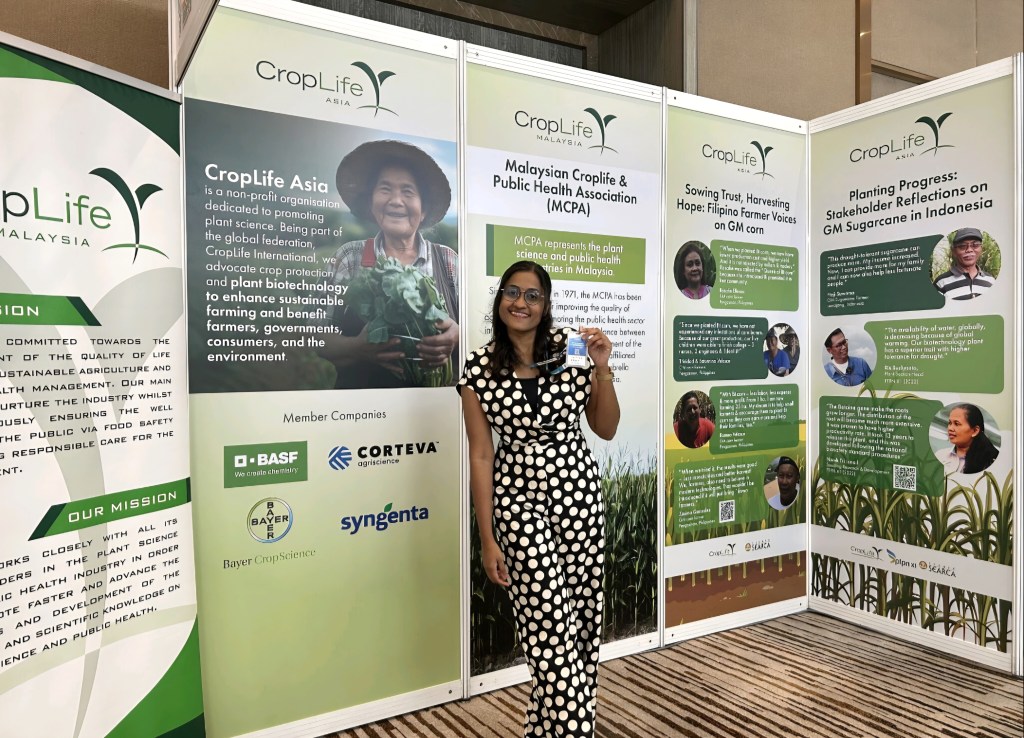
Author: Saarani Vengadesen
Affiliation: PhD Candidate, Regulatory Specialist, Universiti Malaya
Date: 12 October 2025
Malaysia is steadily moving forward in modern biotechnology. The momentum was clear at the recent Biosafety Symposium, officially launched by the Deputy Minister of Natural Resources and Environmental Sustainability Datuk Seri Huang Tiong Sii, that I attended this week. The presence of a senior policymaker sent a strong signal that biotechnology is on the national agenda and that Malaysia recognises its potential for the future.
Organised by the Biosafety Department, the symposium gathered regulators, researchers, and international experts to chart the path forward. It was both a celebration of progress and a wake-up call that Malaysia must move faster if it wants to keep pace with global developments.
Speakers from Indonesia, Thailand, Singapore, the Philippines, and the United Kingdom shared their national experiences, offering valuable lessons and, at times, reminders of how quickly the field is advancing. While Malaysia has long been recognised for its robust regulatory framework, the symposium highlighted that the next challenge is ensuring research and regulation translate into real-world benefits.
Strengths to Build On
Malaysia has already approved 68 biotech events for food, feed, and processing, covering crops such as corn, soybean, potato, cotton, oilseed rape, alfalfa, and sugar beet. These approvals demonstrate that the country is actively participating in the global biotechnology supply chain.
At the same time, our scientific community is making waves in this field since early 2000s. The Malaysian Rubber Board established the world’s first field trial of transgenic rubber trees in 2010 with the aim of enhancing latex production and developing valuable proteins for pharmaceutical use.
This early move shows Malaysia was a front-runner in applying modern biotechnology to one of its most important natural resources, while Malaysian Agricultural Research and Development Institute is currently applying gene editing to paddy lines to improve disease resistance and previously has worked on genetically modified papaya. Malaysian Palm Oil Board is exploring gene editing for oil palm. Together, these efforts reflect Malaysia’s strong R&D base and capacity to innovate.
By comparison, the Philippines has approved 134 genetically modified crop events, including those cultivated locally. The contrast shows that while Malaysia is on the right path, more work is needed to move research beyond the laboratory.
Moving Ahead with Gene Editing
Encouragingly, Malaysia is also taking steps to embrace new breeding techniques such as gene editing. A landmark decision was made recently to exempt SDN-1 (Site-Directed Nuclease 1) applications from the strict GMO regulatory framework.
What does this mean in practice? In SDN-1 gene editing, scientists make a small, precise cut in a plant’s DNA, which the cell naturally repairs. No foreign DNA is added. The result is a tiny change, similar to what could occur naturally or through traditional breeding, but achieved far more quickly and accurately.
This exemption is significant. It reduces regulatory hurdles, making it easier for researchers and companies to develop crops that address Malaysia’s specific needs, such as climate-resilient rice, disease-resistant rubber, or higher-yielding oil palm. It also sends a strong signal to investors that Malaysia is serious about biotechnology innovation. Many leading countries including Japan, Argentina, the Philippines, have adopted similar positions, and Malaysia is wisely keeping pace.
Bridging the Gap
The symposium also highlighted areas how regulatory disharmony could disrupt trade, building public awareness and understanding the role of genetically modified crops in global chain. In 2023, 206.3 million hectares of GM crops were planted in 27 countries and regions.
Of these, public understanding may be the most urgent. Misconceptions about GMOs and gene editing remain widespread. Without transparent communication and sustained public engagement, even the strongest science and regulation may struggle to gain acceptance.
The Role of Political Will
Malaysia has the right ingredients: a sound regulatory system, skilled researchers, and promising R&D projects. But unlocking the benefits of biotechnology will take political will. Biotechnology must be elevated as a national priority not only for innovation’s sake, but as a strategy for food security, trade competitiveness, and climate resilience.
This means creating incentives for commercialisation, strengthening partnerships between public research and industry, and ensuring that breakthroughs do not remain confined to the lab.
A Window of Opportunity
The Biosafety Symposium, launched at the deputy ministerial level, was more than just a meeting of minds; it was a reminder that Malaysia is moving in the right direction. The foundations are in place. The challenge now is to build momentum and move faster.
Malaysia has the framework, the talent, and the ambition. With political will and stronger engagement, the country can turn its potential into progress and take its rightful place as a biotechnology leader in the region.




 Scientect