
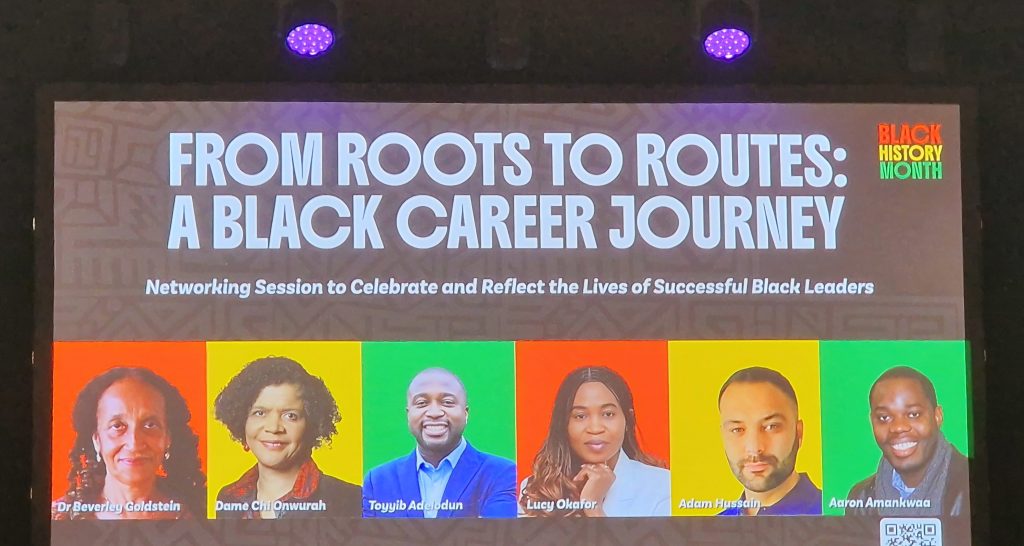
Speaking on the theme “Black History Month: From Roots to Routes: A Black Career Journey“, Dr Aaron Amankwaa shared reflections on his career journey with students and colleagues at Northumbria University (Organiser: Northumbria University Students Union | Date: Thursday, 2nd October 2025 | Venue: Domain Hall, Northumbria University)
Hello, colleagues, friends, and students gathered here today. As we honour Black History Month, we reflect on a story of resilience, innovation, and an unwavering spirit. If you have ever visited the slave forts and castles in Ghana, where I am from, you will probably appreciate this unwavering spirit. That history is not just in the books; it lives in our choices today. My career journey, and yours, is a direct continuation of that legacy.
As I was reflecting on what to share with you today to celebrate Black History Month, I settled on sharing with you four foundational principles that have guided my path. They are more than just career advice; they are a direct inheritance from the strength of our ancestors. They are the Four Pillars of Purpose that define our professional power as Black or African people.
1. The first pillar is one of self-affirmation – Don’t let anyone make you doubt your value and significance in this life. You are of value. You must have a strong conviction of your own dignity, value and self-worth. In rooms where I was the only face that looked like mine, this pillar held me up. In my career journey, I have faced fierce intimidation and a working culture where you are constantly made to feel you must prove yourself to be respected or valued or for your contribution to be taken seriously. But you must have a firm belief that you count, and you must own that truth.
2. Second is sharpening yourself for your goals and dreams. Challenge yourself to become the person who can achieve the big goals and dreams you have. Be purpose driven. My grandfather is a professor of soil science, and I always dreamed of becoming an academic & researcher. I knew early on that to achieve that I had to pursue my masters and a PhD.
Back in Ghana during my undergraduate studies, I had the lowest entry grade in my class, and I knew that in order to achieve my dream, I had to study hard. I developed this passion for learning, studying for about 6 hours almost every day. I ended up top of my class.
I grew up in a single parent home, and my mum is a farmer. Although I performed so well in my studies and had prizes, there was no way I could fund my masters or PhD. I remember shedding tears in my room because of this barrier.
I applied for further studies anyway and had offers… and I also applied for the Commonwealth Shared Scholarship. I had the opportunity to study a masters in forensic science at Strathclyde University in Glasgow and I remember a relative asked how I would be able to afford my flights and accommodation – I told them the scholarship covers everything. After my masters, I went back home, and for almost 8 months, I had no job. I had gone for interviews but heard nothing for months. So, on my decision board, I had three options – set up a business, apply for jobs, and apply for a PhD. because I dreamed of becoming an academic. I did all three, and I finally had the Northumbria University Studentship fund to study my PhD. In summary, be determined to sharpen your skills and your knowledge for your dreams and goals.
3. The third pillar is to be impact focused. Have a perspective or a mindset of impact. Making an impact is more important than titles or awards. Strive to make an impact or a mark in your various fields of endeavour. Focus on impact.
Think of your current role or your next step. What is the tangible difference you are making in your community? For me, my most rewarding moments in my career journey as an academic in forensic biology and forensic science policy haven’t been promotions but seeing for example my research being quoted in debates in the Supreme Court of Brazil to develop their forensic DNA laws and policy, or informing forensic DNA/ biometrics policy in Scotland and the UK or informing forensic science practice and policy in the investigation of gender-based violence in Africa. The ripple effect of genuine, positive impact endures, and these have been the most fulfilling part of my career journey.
4. Finally, the fourth principle is humility and hunger – Be Growth oriented. Have mentors and role models in your circle. People who are already doing what you want to do or be in this life and learn from them. They can be in your own family or community. For me, my PhD Supervisor, who is not even of African ancestry, Prof Carole McCartney, has been a pillar in my career and pushed me to go the extra mile. At the end of my PhD I received a national award, pushed me to provide oral and written evidence to inform laws and policy in the UK, New Zealand, Scotland… the consultations I have done and my achievements as an academic have benefited from her encouragement and inspiration and we continue to work together to date. Mentors can also come from your own family – I mentioned my grandfather who has been an inspiration in my career journey.
So, to summarise, these four pillars: first, your self-worth, second purpose, be impact focused, and lastly be growth oriented – are not abstract concepts. They are the daily decisions that define a career of significance. They are the spirit of Black History, realised in the present moment.
Thank you.




 Scientect
Leave a comment