
Authors: Akwasi Afrane Bediako, Ohene Gyan Raymond & Kwakye Foster
Affiliation: Faculty of Bioscience, University for Development Studies, Ghana
Date: 01 March 2025
Research conducted over the last two decades has validated curcumin’s varied pharmacological effects and demonstrated its promise as a therapeutic and chemopreventive agent for several chronic illnesses.
What is curcumin?
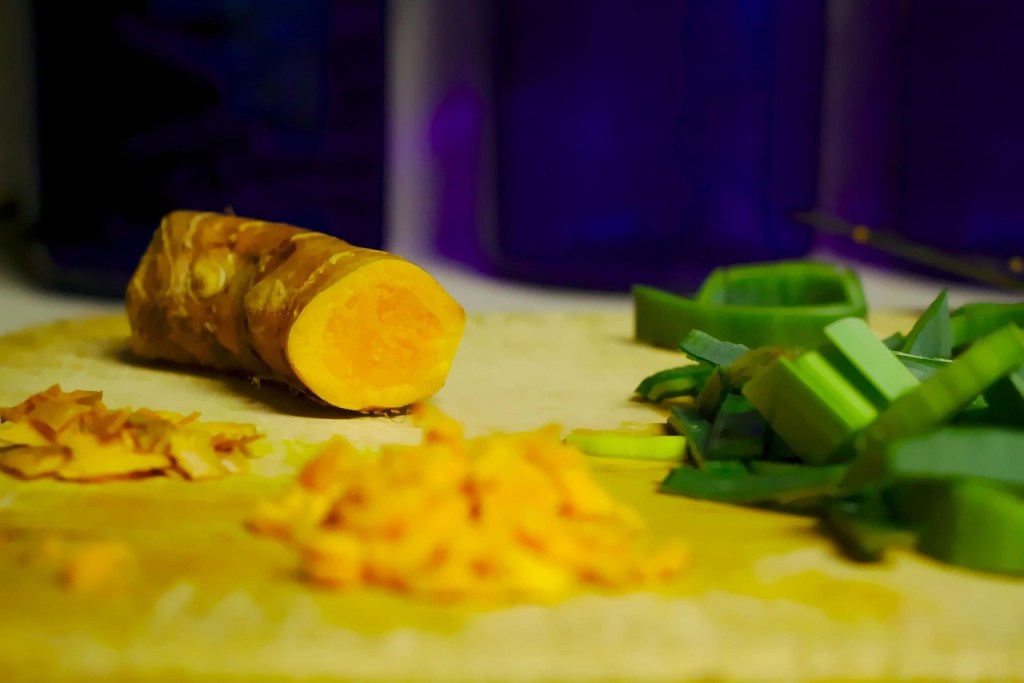
Curcuma longa (turmeric) is a perennial herb. It is widely grown in tropical regions of South and Southeast Asia. The most beneficial portion of this plant for cooking and medicine is the rhizome, often known as the “root.”
Curcumin, the most potent ingredient in turmeric, accounts for about 2–5% of the spice. Curcuminoids, which Vogel isolated for the first time in 1842, give turmeric its distinctive yellow hue. Curcumin, an orange-yellow crystalline powder, is essentially insoluble in water.
In 1910, Lampe and Milobedeska characterized curcumin’s structure as diferuloylmethane (C₂₁H₂₀O₆) (Muñoz-Pinedo et al., 2012). Diferuloylmethane is extensively used as a flavouring agent in food supplements and is responsible for giving turmeric spice its yellow colour.
Curcumin is a low molecular weight polyphenol with a wide range of pharmacological and therapeutic effects. Curcumin exhibits promising pharmacological activities and has demonstrated beneficial effects in terms of cancer cell proliferation, growth, survival, apoptosis, migration, invasion, angiogenesis, and metastasis.
Several reports have demonstrated that curcumin prevents cancer progression through its anti-inflammatory, anti-oxidant, anti-proliferative, and pro-apoptotic mechanisms.
Pharmacokinetics and Metabolism of Curcumin
Studies have shown that curcumin is rapidly and efficiently metabolized in mammals. In a study on rats, a dietary dose of curcumin (1 g/kg) was metabolized and eliminated (75%) during a few hours, mainly in feces and in negligible amounts in the urine, while after intravenous administration, more than 50% of the dose was excreted in the bile within 5 hr.
Analytical data have shown that curcumin is mainly metabolized to curcumin glucuronide and to a lower extent to curcumin sulfate, hexahydrocurcumin, hexahydrocurcuminol, and hexahydrocurcumin glucuronide. In humans, curcumin is efficiently eliminated and is also well tolerated (Shishodia et al.,2013).
Curcumin orally administrated (dose 0.5–8 g daily for 3 months) to patients with preinvasive malignant or high-risk premalignant conditions of the bladder, skin, cervix, stomach, or oral mucosa was well tolerated and its concentrations were found to peak 1–2 hr after intake, and then declined within 12 hr. After administration of a dose of 8g of curcumin daily, its highest concentration determined in blood serum did not exceed 2 μM, which showed that curcumin did not accumulate in the organism.
In a clinical study using a standardized oral Curcuma extract containing mainly curcumin, doses of up to 180 mg of curcumin per day were given to patients with advanced colorectal cancer for up to 4 months without toxic effects or detectable systemic bioavailability (Liczbiński et al.,2020).
Curcumin Reduces Oxidative Stress in Normal Cells
Curcumin exhibits strong antioxidative properties that are comparable to activities of vitamin C or E. It has been documented that curcumin is a scavenger of reactive oxygen species (ROS) and reactive nitrogen species (RNS) including superoxide anion, hydroxyl radical, and nitrogen dioxide.
Curcumin has also been shown to inhibit oxidative damage including lipid peroxidation in various animal models. Moreover, this substance is capable of activating enzymatic antioxidant responses through the activation of genes coding superoxide dismutase, catalase, glutathione peroxidase and S-glutathione transferase (Shehzad et al.,2013).
Curcumin Effects on Cell Cycle in The G1/S and G2/M Phase in Cancer Cells
Studies showed that curcumin (in concentration 10 μg/mL–27 μM) caused cell cycle arrest followed by an anti-proliferative effect and induction of apoptosis in human osteosarcoma (HOS) cell line (ATCC CRL-1543) in vitro. Before curcumin-induced apoptosis, it had inhibited the cell cycle; the cells were arrested in the G1/S phase, and subsequently in the G2/M phase.
Consequently, it was, for the first time, demonstrated that curcumin can arrest the cell cycle at its different phases. To assess the molecular mechanism of curcumin action, those researchers assessed changes in cell cycle regulatory protein levels (Shishodia et al.,2005).
Cyclin D1 is one of the cyclins required to pass from G1 to the S phase. A decrease in cyclin D1 level is one of the main causes of cell cycle arrest at the G1/S phase, which was observed in curcumin-treated HOS cells. On the other hand, the cdc2/cyclin B complex is one of the main elements regulating the progression of the G2 to M phase.
Arresting the cell cycle at the G2/M phase after treatment with curcumin is associated with the reduction of cdc2/cyclin B complex formation, which is a necessary step for cells to undergo mitosis. It may be concluded that curcumin causes the death of HOS cells by cell cycle arrest sequentially in the G1/S and G2/M phases (Liczbiński et al.,2020).
Curcumin Influences Apoptosis in Cancer Cell
The anticancer action of curcumin is mainly associated with its antiproliferative and proapoptotic effects, which have been mostly shown in vitro studies in human colon cancer cells, human papillary thyroid carcinoma cells (BCPAP), K562 cell line of CML and in B-precursor lymphoblastic leukemia (ALL) (B-Pre-ALL) cell lines. In vivo, curcumin has been shown to prevent cancer cell spread and inhibit angiogenesis (Shishodia et al.,2005).
Endoplasmic Reticulum is the main organelle for the synthesis, maturation, and formation of spatial structure of proteins. To some extent, the fate of the cell is determined by the balance between survival and apoptotic signaling, while the specific ER stressor, plays a key role in adjusting cell homeostasis.
To balance extracellular stimulation, the unfolded protein response (UPR) is activated to reduce the misfolded structure of proteins. Increased stress in ER initiates apoptotic cell death, which may be dependent or independent of mitochondrial signalling.
Conclusion
Curcumin is a promising natural phytochemical with significant potential in cancer cells that aid in the inhibition of cancer cell proliferation. Its ability to alter multiple cellular pathways in cancer cells, including glucose metabolism, protein regulation, and oxidative stress.
Curcumin’s anti-inflammatory and antioxidant properties most likely contribute to its health benefits. It can alter gene expression, a wide range of molecular targets, and many signalling pathways. Although curcumin has shown promise as a medication in many clinical trials, its poor solubility, colour, and low bioavailability still restrict its therapeutic application.
Several approaches, like a combination with other agents or synthetic analogues of curcumin, are being developed to improve its bioavailability and efficacy. All things considered, curcumin’s pharmacological safety, therapeutic potential, affordability, and adaptability make it highly likely that it will be developed as a therapeutic medication.
References
Chae, H. S., & Hong, S. T. (2022). Overview of cancer metabolism and signaling transduction. International Journal of Molecular Sciences, 24(1), 12. https://doi.org/10.3390/ijms24010012
Liczbiński, P., Michałowicz, J., & Bukowska, B. (2020). Molecular mechanism of curcumin action in signaling pathways: Review of the latest research. Phytotherapy Research, 34(8), 1992-2005. https://doi.org/10.1002/ptr.6663
Liczbiński, P., Michałowicz, J., & Bukowska, B. (2020). Molecular mechanism of curcumin action in signaling pathways: Review of the latest research. Phytotherapy Research, 34(8), 1992-2005. https://doi.org/10.1002/ptr.6663
Muñoz-Pinedo, C., El Mjiyad, N., & Ricci, J. E. (2012). Cancer metabolism: current perspectives and future directions. Cell death & disease, 3(1), e248-e248. https://doi.org/10.1038/cddis.2011.123
Priyadarsini, K. I. (2014). The chemistry of curcumin: from extraction to therapeutic agent. Molecules, 19(12), 20091-20112. https://doi.org/10.3390/molecules191220091
Shehzad, A., & Lee, Y. S. (2013). Molecular mechanisms of curcumin action: signal transduction. Biofactors, 39(1), 27-36. https://doi.org/10.1002/biof.1065
Shishodia, S. (2013). Molecular mechanisms of curcumin action: gene expression. Biofactors, 39(1), 37-55. https://doi.org/10.1002/biof.1041
Shishodia, S., Sethi, G., & Aggarwal, B. B. (2005). Curcumin: getting back to the roots. Annals of the New York Academy of sciences, 1056(1), 206-217. https://doi.org/10.1196/annals.1352.010



 Scientect