
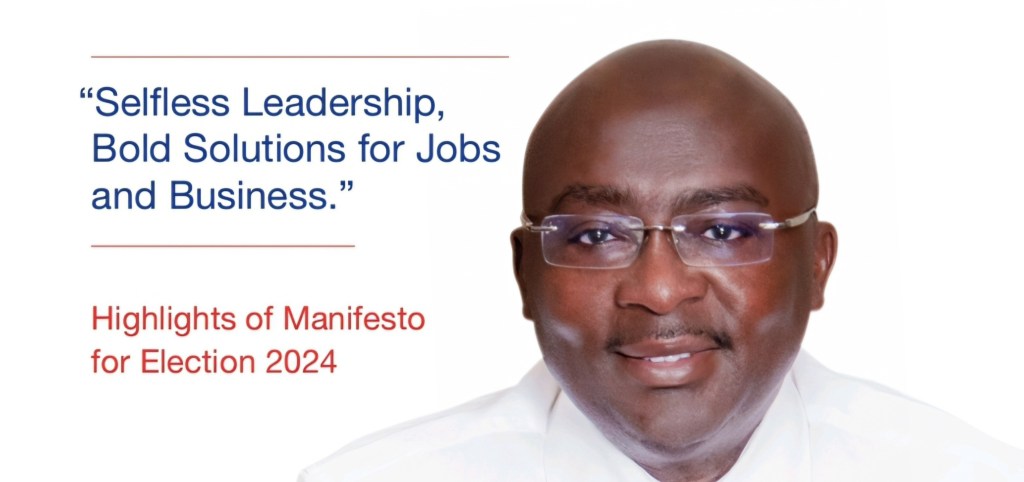
The New Patriotic Party’s (NPP) 2024 manifesto launch on August 18, 2024, was a momentous occasion that sought to reinvigorate a party that has faced significant challenges in recent years. With Dr. Mahamudu Bawumia at the helm, the NPP is hoping to reclaim the trust of Ghanaians, especially those who have grown disillusioned with the party’s performance during its last eight years in power.
The manifesto, filled with a mixture of new promises and reiterations of past achievements, reflects Bawumia’s vision for a brighter future. However, the question remains: Can Bawumia’s vision revive the NPP’s waning popularity?
The 2024 manifesto places considerable emphasis on the achievements of the NPP’s first term, particularly the Free Senior High School (SHS) program, which has become the cornerstone of their educational policy. It’s clear that the NPP views Free SHS as their golden ticket, a legacy they continue to flaunt even as other areas of governance face scrutiny.
Bawumia’s administration promises to build on this achievement by further expanding access to SHS and improving Technical and Vocational Education and Training (TVET). While these educational initiatives are commendable, they also underscore a deeper issue – the NPP’s apparent reliance on past successes to mask their more recent failures.
The party’s second term under Nana Akufo-Addo was marred by a series of broken promises. The administration’s initial strong performance in macroeconomic management, infrastructure development, and social interventions like Free SHS was overshadowed by its struggles in the latter half.
Ghanaians watched as promises like “no return to the IMF” and “no mobile money tax” were reneged upon, leading to a growing sense of betrayal among the electorate. The economic situation worsened dramatically during Nana Addo’s second term, exacerbated by external factors like the COVID-19 pandemic and the Russia-Ukraine war.
However, the administration’s insistence on blaming these external events, while valid to some extent, often felt like an excuse to many Ghanaians who expected better crisis management from their leaders.
Against this backdrop, Bawumia’s manifesto aims to chart a new course, promising reforms that are intended to address the key concerns of Ghanaians today – namely, the cost of living, unemployment, and infrastructure development.
The manifesto’s focus on economic policies, such as a simplified flat tax regime and incentivising the private sector to take on a larger role in public service provision, signals a shift towards a more market-driven approach to governance. Bawumia’s economic policies are designed to stimulate growth by making it easier for businesses to thrive, thereby creating jobs and reducing the burden on government finances. This approach is emblematic of Bawumia’s technocratic background, which he hopes will resonate with voters tired of the old ways of doing things.
However, it remains to be seen whether these promises will be enough to sway voters who feel let down by the NPP’s recent track record. The focus on private sector involvement and public-private partnerships (PPPs) in infrastructure development, while innovative, could also be seen as a continuation of the same neoliberal policies that have often been criticised for prioritising profit over people.
There is also the question of whether these policies will actually be implemented as promised, given the NPP’s history of falling short on key pledges.
Another significant aspect of the 2024 manifesto is the NPP’s commitment to digitisation and innovation. Building on the successes of the Ghana Card and other digital initiatives, Bawumia’s vision is to further integrate technology into governance, with the goal of increasing efficiency and reducing corruption. This push for digitisation is a double-edged sword. On one hand, it positions Ghana as a forward-looking nation ready to embrace the digital economy. On the other hand, it risks alienating those who feel left behind by the rapid pace of technological change, particularly in rural areas where access to digital infrastructure remains limited.
Moreover, the manifesto’s emphasis on anti-corruption measures and improved governance, while laudable, is met with skepticism by a public that has heard similar promises before. The NPP’s previous attempts to tackle corruption have often been criticised for being too lenient on political allies and too focused on small-scale offenders. Bawumia’s promise to strengthen anti-corruption institutions and enforce stricter penalties is certainly a step in the right direction, but it will take more than words to convince a weary electorate that things will be different this time around.
Bawumia’s manifesto also highlights a number of social policies aimed at improving the lives of ordinary Ghanaians, including the expansion of healthcare services through telemedicine and drone delivery, and the promotion of gender equality through initiatives like the Women’s Trade Empowerment Fund. These policies, while important, may struggle to capture the imagination of voters who are more concerned with bread-and-butter issues like job creation and inflation.
Ultimately, the success of the NPP’s 2024 campaign will hinge on whether Ghanaians believe that Bawumia can deliver on his promises. While the manifesto contains many good ideas, the party’s credibility has been significantly eroded by the failures of the past eight years.
Bawumia’s challenge is not just to articulate a compelling vision for the future, but to convince voters that this time, the NPP will follow through.



 Scientect